
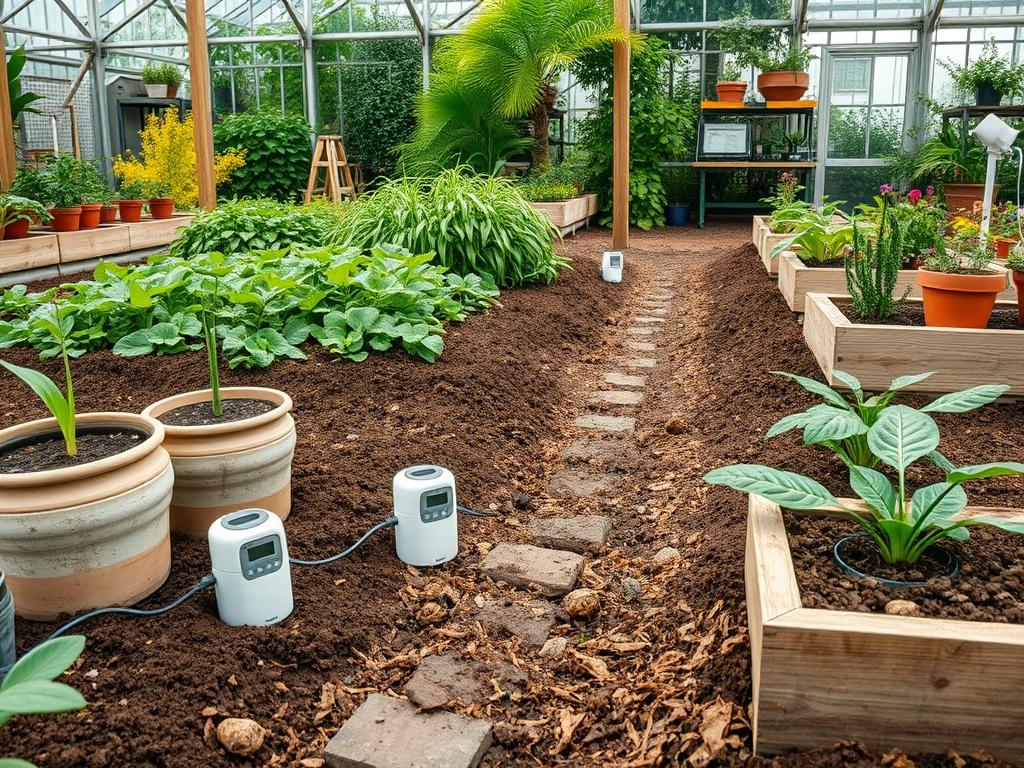
Modern landscaping requires a delicate balance between aesthetic elegance and scientific precision. The most striking properties often hide complex engineering beneath the surface, where practitioners manage soil health, drainage, and hydration with rigorous care. One of the persistent challenges in professional landscape design is maintaining the health of the rhizosphere, the critical zone surrounding plant roots. Standard irrigation schedules often fail to account for the micro-climates created by shadows, wind corridors, or varying soil compositions. To address this, high-performance designs now integrate Smart Mulch Depth Sensors for Soil Moisture to provide real-time data on the environment beneath the organic cover. These tools allow architects to maintain curb appeal while drastically reducing water waste.
Successful outdoor environments depend on a healthy layer of organic mulch to regulate soil temperature and suppress weeds. However, mulch is not a static element. It decomposes, shifts during heavy rain, and can be displaced by wind or maintenance activities. When the mulch layer thins, soil moisture evaporates rapidly, leading to plant stress. Conversely, mulch that is too thick can prevent oxygen from reaching the roots or harbor fungal pathogens. By utilizing Smart Mulch Depth Sensors, landscape consultants can monitor the exact thickness of the protective layer alongside moisture levels. This data ensures that the irrigation system only activates when the soil truly requires it, rather than adhering to a rigid, inefficient clock.
The integration of technology into the landscape does not detract from its natural beauty; rather, it preserves it. When we design for longevity, we must consider the climate trends of the region, such as prolonged heat waves or erratic spring frosts. A garden that looks pristine in April must also withstand the localized drought of August. Utilizing sensors provides a feedback loop that informs us when the mulch needs to be replenished to protect sensitive root systems. This level of oversight is particularly crucial for estate management and commercial properties where the cost of replacing mature specimens is high.
Landscape Design Principles
Effective landscape design starts with the principle of symmetry and visual balance, ensuring that the eye moves naturally across the environment. We look for focal points, perhaps a specimen tree like a Japanese Maple or a modern stone sculpture, to anchor the space. However, the structural integrity of these designs relies on elevation layers and grading. Proper grading ensures that water moves away from the foundation of the home while settling in areas where it can be absorbed by the water table. Smart Mulch Depth Sensors are often placed at varying elevations to track how water moves through the property.
Irrigation planning is the next critical pillar. We no longer rely on broad-spectrum sprayers that waste water on walkways; we use precision drip lines and subsurface emitters. By placing sensors near these emitters, we can confirm the lateral movement of water through the soil. This prevents dry spots and ensures that the visual balance of the garden is not compromised by patchy growth or yellowing leaves. Furthermore, the use of retaining walls can create micro-terraces that require different moisture profiles. A sensor at the top of a slope and one at the base can reveal the hydrological variance across the elevation changes.
Finally, walkways and hardscaping must be integrated with the softscape in a way that allows for natural drainage. We use permeable pavers or gravel paths to reduce runoff. When these hard surfaces meet the mulch beds, the sensors help us understand if the hardscaping is causing heat islands that accelerate moisture loss in the adjacent soil. This data-driven approach allows for a landscape that is both beautiful and ecologically responsible.
Plant and Material Selection
The following table outlines plants and materials commonly used in high-end, sensor-monitored landscapes to ensure maximum health and performance.
| Plant Type | Sun Exposure | Soil Needs | Water Demand | Growth Speed | Maintenance Level |
| :— | :— | :— | :— | :— | :— |
| Purple Coneflower | Full Sun | Well-drained | Low | Moderate | Low |
| Dwarf Fountain Grass | Partial Sun | Loamy | Moderate | Fast | Low |
| Boxwood Shrub | Partial Shade | Moist/Rich | Moderate | Slow | Medium |
| Blue Switchgrass | Full Sun | Sandy/Clay | Low | Fast | Low |
| Oakleaf Hydrangea | Shade | Acidic/Moist | High | Moderate | Medium |
| Creeping Thyme | Full Sun | Sandy | Low | Moderate | Low |
For mulching materials, we prioritize Shredded Cedar Bark or Fine Pine Bark Mulch. These organic materials provide excellent thermal insulation. For modern, minimalist designs, we may use Black Volcanic Rock or Pea Gravel, though these require different sensor calibration since they do not decompose or absorb water in the same manner as organic matter.
Implementation Strategy
The planning phase begins with a detailed site analysis to determine the existing soil structure. We look for signs of compaction or poor drainage before any plants go into the ground. Once the layout is marked with Landscape Stakes, we execute the grading process. This involves shaping the land to direct water flow into designated bioswales or drainage pipes. Following the grade, we install Steel Edging or Stone Borders to provide a clean transition between lawn areas and planting beds.
When it comes to the actual planting, we ensure each hole is dug twice as wide as the root ball to encourage lateral root expansion. After the plants are in place, we install the Drip Irrigation lines, securing them with Landscape Staples. This is the prime moment to install the Smart Mulch Depth Sensors. We place them in representative zones: one in a high-sun area, one in the shade, and one near the largest specimen trees.
The sensors are calibrated to the specific soil type, whether it is heavy clay or porous sand. We then apply a consistent layer of Organic Mulch to a depth of 3 inches. The sensors will immediately begin transmitting data, allowing us to see if the mulch is providing the intended moisture retention. During the final phase, we check the hardscaping joints and ensure all drainage basins are clear of debris. This systematic approach guarantees that the landscape is set up for long term success from day one.
Common Landscaping Failures
One of the most frequent mistakes in professional landscaping is the creation of “mulch volcanoes.” This occurs when mulch is piled high against the trunk of a tree, trapping moisture against the bark and leading to rot and pest infestation. Smart Mulch Depth Sensors can alert a property manager if the mulch depth exceeds safe limits near sensitive trunks. Another common failure is improper spacing; plants that look perfect at a nursery often grow to three times their size in three years. We must design with the mature width in mind to prevent root overcrowding and poor air circulation.
Drainage mistakes can also be catastrophic. If the grade tilts back toward the house or creates standing pools in the lawn, the soil becomes anaerobic, essentially drowning the plants. Furthermore, soil compaction from heavy machinery during construction often goes unaddressed. If the soil is not tilled and amended with Organic Compost, no amount of irrigation or mulch will save the plants. Irrigation inefficiencies, such as misaligned sprinkler heads or broken lines, often go unnoticed until a plant dies. Using sensors allows us to detect these subsurface issues early, as a sudden drop in soil moisture despite a scheduled watering move indicates a system failure.
Seasonal Maintenance
Landscape management is a year-round commitment that changes with the cycles of the sun. In the Spring, we focus on cleaning up debris and inspecting the sensor batteries. This is the time to apply a fresh layer of mulch to reach that ideal 3-inch depth and to prune any winter-damaged limbs using Bypass Pruners. As we transition into Summer, the priority shifts to moisture management. We monitor the sensor data daily to adjust irrigation run times, ensuring the soil stays hydrated during extreme heat without over-saturating the root zones.
During the Autumn, we prepare the landscape for dormancy. We may reduce irrigation frequency as the evapotranspiration rate drops. Fall is also the time to plant spring-blooming bulbs and to apply a final layer of mulch to insulate the ground against the coming frost. In Winter, maintenance involves protecting sensitive species with Burlap Wraps and ensuring that drainage paths are clear of ice and snow. We also use this quiet season to analyze the previous year’s sensor data, looking for patterns that might suggest the need for layout changes or plant replacements in the following spring.
Professional Landscaping FAQ
How deep should my mulch layer be for optimal moisture?
For most garden beds, a depth of 2 to 3 inches is ideal. This thickness suppresses weeds and retains moisture without suffocating the soil. Use sensors to monitor settling and decomposition over time to maintain consistency.
Can sensors distinguish between rain and irrigation?
Smart sensors track the rate of moisture increase and duration. While they measure total soil volumetric water content, integrated weather apps help the software distinguish between natural precipitation and scheduled irrigation events to optimize water usage.
Where is the best place to install a moisture sensor?
Install sensors in the root zone of your most valuable or water-sensitive plants. Ensure the probe is buried at a depth of 6 to 8 inches where the majority of active root uptake occurs for shrubs and perennials.
Does mulch depth really impact plant health?
Yes, inconsistent mulch depth leads to fluctuating soil temperatures and moisture levels. A thin layer allows the soil to bake in the sun, while a layer exceeding 4 inches can prevent essential gas exchange between the soil and atmosphere.
What is the best type of mulch for water conservation?
Coarse organic mulches, such as Shredded Bark or Wood Chips, are superior for water conservation. They create a complex web that slows evaporation while allowing rainwater to easily penetrate through to the soil surface below.