
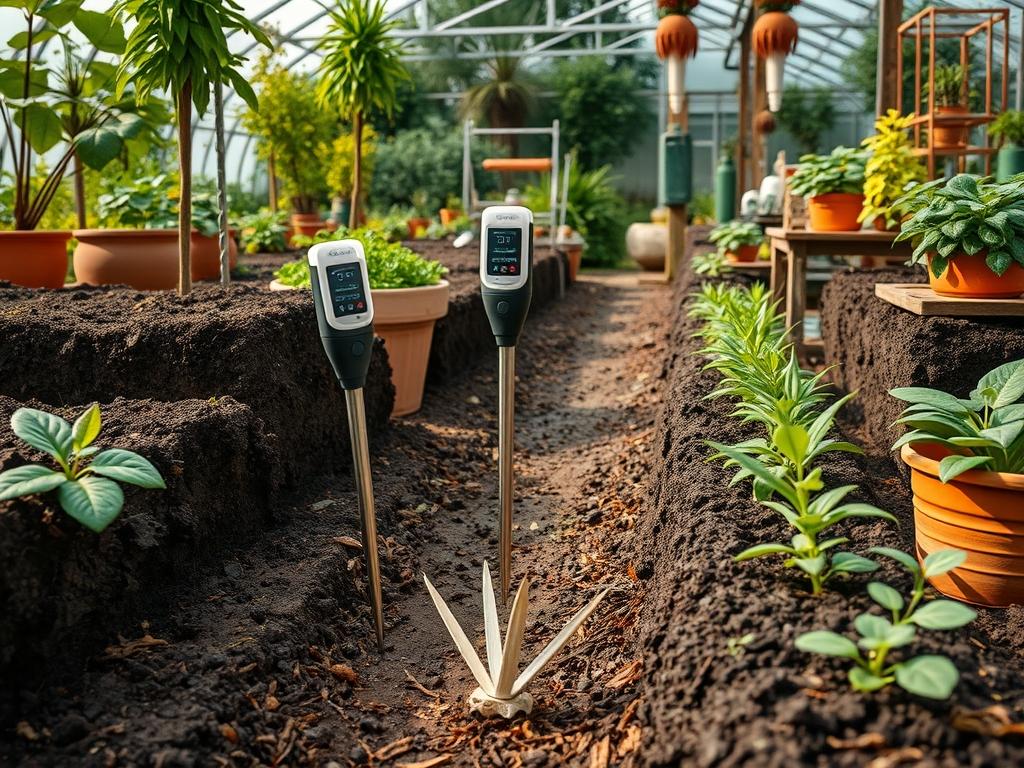
Modern landscape architecture requires a delicate balance between artistic vision and agronomic precision. Professional designers understand that a stunning outdoor environment is not merely a collection of decorative elements but a complex living system that demands constant monitoring. The challenge often lies in the invisible variables, specifically the subterranean conditions that dictate the health of expensive flora. Achieving high curb appeal and functional outdoor living spaces depends on your ability to manage soil moisture, salinity, and temperature fluctuations. This is where Smart Garden Soil Probes become indispensable tools. By providing real time data from the root zone, these devices allow consultants to move beyond guesswork and enter the realm of precision land management.
Managing a large estate or a complex commercial landscape involves navigating diverse microclimates within a single property. A north facing slope may retain moisture for days, while a sun drenched terrace dries out in hours. Traditional irrigation schedules often fail to account for these variances, leading to either parched perennials or root rot. Utilizing Smart Garden Soil Probes ensures that your irrigation system responds to actual environmental needs rather than a static timer. This data driven approach preserves the structural integrity of your softscape and prevents the costly replacement of mature specimens. Ultimately, a successful landscape is one where the infrastructure supports the biology, creating a seamless transition between the built environment and the natural world.
Landscape Design Principles
Symmetry and visual balance are the hallmarks of high end landscape design. When a designer installs a row of European Hornbeam to create a formal screen, any discrepancy in growth rates will destroy the intended geometric perfection. Probes allow us to monitor the nutrient and moisture levels of each individual tree, ensuring that the entire line receives uniform care. If one section of soil has higher Electrical Conductivity (EC), indicating a salt buildup, the data will alert the manager before the foliage shows signs of stress or chlorosis.
Focal points and elevation layers add depth to a garden, but they also complicate water distribution. A raised planter box or a tiered retaining wall will naturally shed water faster than a flat lawn. Incorporating elevation sensors alongside soil probes helps architects understand how gravity affects the hydration of different zones. When planning walkways and hardscaping, it is crucial to consider how pavers and concrete reflect heat into the surrounding soil. Placing a probe near these thermal masses helps adjust irrigation to counteract the increased evaporation rates, protecting delicate groundcovers like Irish Moss.
Functional irrigation planning must also consider the “hydrozone” concept. Grouping plants with similar water requirements is a foundational principle, but even within a hydrozone, soil texture can vary. A professional layout utilizes Smart Garden Soil Probes at various depths, typically 4 inches for turf and 12 to 18 inches for shrubs. This vertical data mapping allows the consultant to see how deep the water is penetrating, ensuring that deep rooted trees are truly hydrated while preventing surface level saturation that encourages fungal growth.
Plant and Material Selection
The following table outlines common selections for modern landscapes and the specific conditions that must be monitored using professional grade sensors.
| Plant Type | Sun Exposure | Soil Needs | Water Demand | Growth Speed | Maintenance Level |
| :— | :— | :— | :— | :— | :— |
| Japanese Maple | Partial Shade | Well drained, Acidic | Moderate | Slow | High |
| Blue Oat Grass | Full Sun | Lean, Sandy | Low | Medium | Low |
| Hydrangea Macrophylla | Part Shade | Rich, Moist | High | Fast | Moderate |
| Boxwood | Full to Part Sun | Neutral pH, Loamy | Moderate | Slow | High |
| Lavender | Full Sun | Rocky, Alkaline | Very Low | Medium | Low |
| Creeping Thyme | Full Sun | Gritty, Poor soil | Low | Fast | Low |
When selecting materials, the choice of mulch is just as important as the plants themselves. Double shredded hardwood mulch provides excellent moisture retention and organic matter, but it can also become hydrophobic if allowed to dry out completely. A probe placed beneath a 3 inch layer of mulch provides the only accurate way to tell if water is actually reaching the soil or simply running off the surface. For modern, minimalist designs, crushed basalt or river rock are often used. These inorganic materials can drastically increase soil temperature, requiring the use of temperature sensitive probes to prevent the boiling of sensitive root systems.
Implementation Strategy
Professional implementation starts with a rigorous site analysis. Before any hole is dug, the land must be graded. Proper drainage requires a 2 percent slope away from the home foundation and any permanent structures like retaining walls. Once the grading is established, we map the locations for the sensors. For a standard residential backyard, one probe should be placed in the highest elevation zone and another in the lowest. This allows the property owner to monitor the extremes of the drainage spectrum.
Edging and hardscaping should be installed before the final planting phase. Use steel edging or poured concrete curbs to create clean lines and prevent the migration of invasive turf roots into ornamental beds. When the plants are finally installed, the soil probes must be calibrated to the specific soil type. A clay heavy soil has a much higher water holding capacity than sandy loam, meaning the “low moisture” alert threshold will be different for each.
The final step of implementation is the application of geotextiles and drainage layers. In areas prone to pooling, a French drain topped with 1 inch clean stone can be monitored with a probe to ensure the water is moving as intended. If the probe data shows constant saturation despite a drainage system, it indicates a blockage or a need for a more aggressive sump pump solution.
Common Landscaping Failures
The most frequent failure in high end landscaping is improper drainage. Many designers focus on the surface beauty while ignoring the hydraulic load beneath. When water stagnates, it displaces oxygen, leading to anaerobic conditions that kill even the most resilient native plants. Soil probes act as an early warning system, detecting high moisture levels long before the plant enters a state of permanent wilting.
Root overcrowding and improper spacing are structural mistakes that manifest over years. When trees are planted too close to walkways or retaining walls, the lack of soil volume leads to rapid resource depletion. A probe can identify these “stress zones” early, allowing for supplemental fertilization or the installation of root barriers. Soil compaction is another silent killer, often caused by heavy machinery during the construction phase. Compacted soil has tiny pore spaces, making it difficult for water to penetrate and for probes to be inserted. If a 12 inch probe cannot be easily pushed into the soil by hand, it is a clear sign that core aeration is required to restore soil health.
Seasonal Maintenance
Landscape management is a year round commitment. During the Spring, the focus is on re-calibration. As the ground thaws, the sensors should be checked for battery life and signal strength. This is the time to apply organic compost and refresh mulch to a depth of 3 inches. The probes will help monitor the soil temperature, telling you exactly when it is warm enough to begin planting tender annuals.
Summer maintenance is defined by irrigation efficiency. During heatwaves, the evaporation rate increases significantly. Professional consultants use probe data to implement “cycle and soak” programs, where water is applied in short bursts to allow for maximum absorption in parched soil. In the Autumn, the goal shifts to dormancy preparation. Reducing water as temperatures drop encourages plants like Oak and Maple to harden off for the winter. Probes ensure the soil remains moist enough to prevent desiccation during the first few freezes.
Finally, Winter is the season for data analysis. Reviewing the year’s moisture and temperature trends allows for a more informed strategy in the coming year. In colder climates, probes can be left in the ground if they are rated for freezing temperatures, providing data on the frost line depth. This information is vital for protecting the root balls of newly planted evergreens that are susceptible to winter burn.
Professional Landscaping FAQ
How many soil probes do I need for a 1,000 square foot garden?
For a standard 1,000 square foot area, we recommend at least three probes. Place one in a high sun area, one in partial shade, and one at the lowest elevation point to capture a complete moisture profile.
Can these probes work with my existing automatic sprinkler system?
Many modern Smart Garden Soil Probes integrate directly with smart irrigation controllers via Wi-Fi or Bluetooth. This allows the system to automatically skip a watering cycle if the soil moisture is already above a specified percentage.
Do probes measure fertilizer levels in the soil?
Yes, advanced probes measure Electrical Conductivity (EC). High EC readings usually indicate a high concentration of dissolved salts from fertilizers. This helps prevent over-fertilization, which can burn the roots of sensitive species like Azaleas.
What is the ideal depth for probe placement?
For turf grass, a depth of 4 inches is sufficient. For larger shrubs and ornamental trees, the probe should be placed at least 12 inches deep to accurately monitor the moisture available to the primary root mass.
How often do the sensors need to be replaced?
Professional grade sensors are designed for durability and typically last 3 to 5 years. However, you should inspect the probes annually for signs of corrosion or damage from landscaping equipment like edgers and lawnmowers.